Godavari Waters Reach Anakapalli Through Polavaram Left Canal
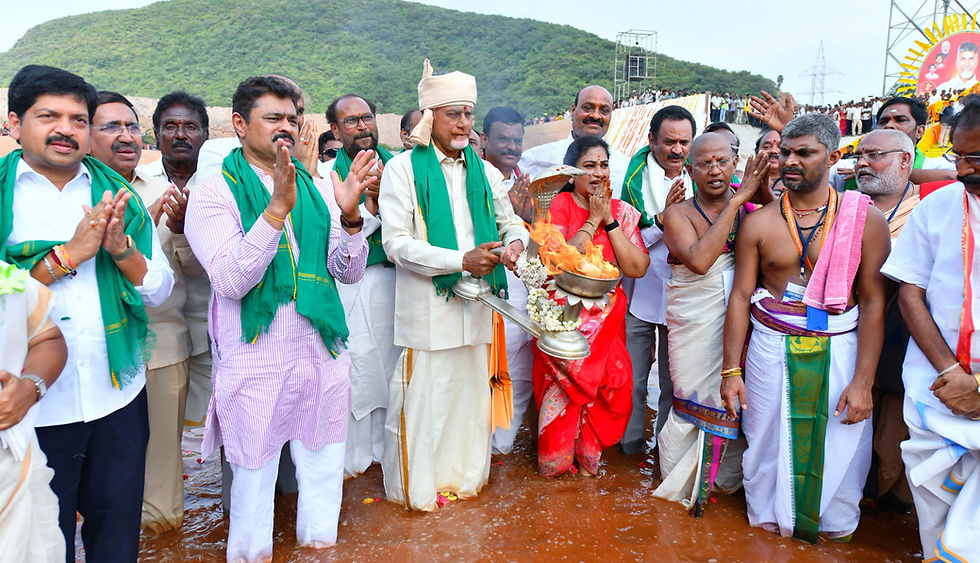
ANAKAPALLI, Andhra Pradesh: Chief Minister N. Chandrababu Naidu on Wednesday, September 2, marked the arrival of Godavari water in North Andhra through the Polavaram Left Main Canal, opening the canal regulator at Payakaraopeta in Anakapalli district and performing a traditional Jala Harathi. The event represents an important expansion of Godavari water supplies toward North Andhra.
Irrigation officials said the water now being supplied is being lifted from the Godavari near Purushothapatnam in Seethanagaram mandal and routed into the Polavaram Left Main Canal. About 3,500 cusecs was planned to be drawn under the current arrangement. The Purushothapatnam Lift Irrigation Scheme was specifically developed to pump Godavari water into the Left Main Canal and toward the Yeleru system.
Naidu has separately set March 2027 as the target for completing Phase I works of the main Polavaram project, which is intended ultimately to allow gravity-based supply through the canal system.
Current government plans envisage irrigation benefits for about 2.87 lakh acres across East Godavari, Kakinada, Konaseema and Anakapalli districts. Anakapalli alone is expected to account for roughly 1.5 lakh acres, with plans to use the water to replenish the Yeleru canal and 110 tanks.
The Polavaram Project Authority says the Left Main Canal was designed to irrigate four lakh acres and provide 23.44 TMC ft of water for industrial and drinking-water requirements in and around Visakhapatnam. That four-lakh-acre figure represents the canal's planned command area rather than the immediate acreage covered by Wednesday's release.
Naidu told the Payakaraopeta gathering that the canal would be extended further into North Andhra and linked with the Uttarandhra Sujala Sravanthi project. He said his government intends to take Godavari water toward Simhachalam next year and subsequently toward Arasavalli and the Vamsadhara river system. He also announced plans to complete 12 major irrigation projects in North Andhra at an estimated ₹3,200 crore; these remain government commitments rather than completed projects.
The water programme is also being tied to the government's broader development plans for the Visakhapatnam-Anakapalli corridor. Naidu argued that future industrial and data-centre demand could be supported by expanded water infrastructure and pointed to plans for subsea connectivity and technology investment in Visakhapatnam.
That technology push has a significant U.S.-India dimension. Google broke ground in April on its Visakhapatnam AI hub, part of a planned $15 billion investment from 2026 through 2030. Google says the project will include gigawatt-scale data-centre infrastructure and an international subsea gateway, while its wider “America-India Connect” initiative includes new subsea routes linking India with Singapore, South Africa and Australia.
For Telugu Americans with family, business or professional links to Andhra Pradesh, that intersection of water infrastructure and Visakhapatnam's emerging technology corridor could be the most consequential longer-term aspect of the development. The immediate milestone is the movement of Godavari water farther into North Andhra; the larger test will be completing Polavaram and the associated distribution infrastructure needed to deliver those benefits reliably.



Comments