Chiranjeevi at 71: The Telugu Megastar Who Kept Rewriting the Role
From a film-institute hopeful with no established cinema background to the defining mass star of a generation, philanthropist, politician, comeback hero and still-working leading man, Chiranjeevi’s public life has tracked nearly five decades of change in Telugu society and cinema.
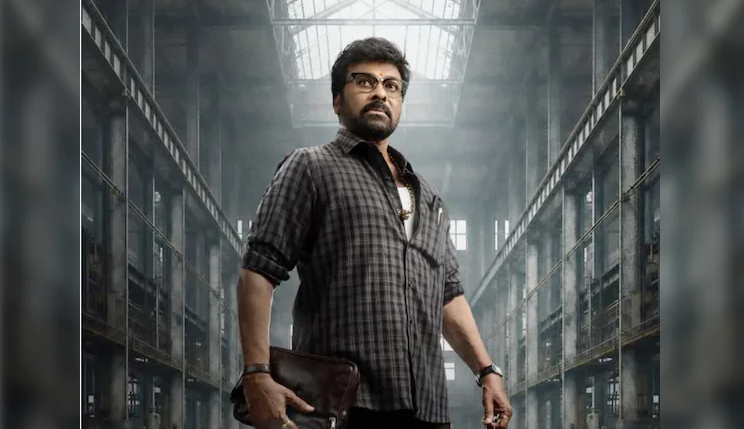
On Chiranjeevi’s 71st birthday, Telugu cinema did not present him as a monument to the past. It gave him another character.
The title glimpse of Kaaka, his new film with director Bobby Kolli, introduces him as K. Satyam, an apparently ordinary supervisor at an aqua-industry workplace. Inevitably, the glimpse suggests that there is much more to the man than the uniform reveals. The film is scheduled for January 13, 2027, continuing Chiranjeevi’s extraordinary run as a leading man almost half a century after his first release.
There could hardly be a more appropriate birthday image.
For most of Chiranjeevi’s public life, there has been something more behind the visible identity: the small-town commerce graduate behind the movie star; the actor behind the “mass hero”; the social-service organizer behind the fan clubs; the uncertain politician behind the seemingly invincible screen persona; and, in his later years, the veteran repeatedly testing whether his old connection with an audience can survive a radically changed industry.
That journey has included spectacular victories, clear failures, risky reinventions and one remarkably durable relationship with Telugu audiences.
Before “Chiranjeevi,” there was Siva Sankara Vara Prasad
Born on August 22, 1955, in Mogalthur in the West Godavari region, he grew up as Konidela Siva Sankara Vara Prasad. His father’s transferable government job meant that his schooling was spread across several towns. He eventually studied commerce at Sri Y.N. College in Narsapur before heading to Madras, now Chennai, to train as an actor.
This part of the story matters because Chiranjeevi entered cinema without an established film family waiting to launch him. The outsider narrative that later became central to his appeal was not manufactured after stardom; it was embedded in the beginning.
In a 1997 interview, Chiranjeevi recalled that while he was still at film school, fellow actor Sudhakar recommended him for a role he could not take. Chiranjeevi obtained permission from his institute, acted in the project and was subsequently noticed by producer Kranthi Kumar. Pranam Khareedu, released on September 22, 1978, became his first film to reach theatres, although Punadhirallu was his earlier acting assignment.
There was no instant coronation.
Early Chiranjeevi could be a supporting actor, an anti-hero or even an antagonist. Films such as Mana Voori Pandavulu, Idi Katha Kaadu and Nyayam Kavali allowed audiences to notice an actor before the industry fully discovered a star. By the early 1980s, films including Subhalekha and Intlo Ramayya Veedhilo Krishnayya were steadily expanding his place in the market.
Then came 1983.
Khaidi did more than deliver a hit
If Chiranjeevi’s career needs a hinge, it is Khaidi.
A. Kodandarami Reddy’s 1983 action drama transformed him from a rapidly rising actor into a star with an immediately identifiable physical and emotional style. Film scholarship on Telugu popular culture also treats 1983 as a watershed: N.T. Rama Rao had moved from cinema into electoral politics, while Chiranjeevi was emerging as the central figure in a new era of the Telugu “mass film.”
What Chiranjeevi brought was not simply action.
He could move.
His dancing made the male star’s body a central attraction of the Telugu commercial song. His fights had speed. His comedy could suddenly puncture an elevation scene. His characters could be rebellious without appearing emotionally inaccessible. For a younger audience, the hero no longer had to carry himself with the stately distance associated with an earlier generation of stars.
The working man, the angry outsider, the mischievous youth and the protector could all exist in the same star image.
That flexibility became an industrial formula.
Challenge, Pasivadi Pranam, Swayam Krushi, Yamudiki Mogudu, Rudraveena, Jagadeka Veerudu Athiloka Sundari, Gang Leader and Gharana Mogudu did not all ask him to do the same thing. But together they created something larger than individual characters: “Chiranjeevi” became a genre expectation.
By the end of that period, “Supreme Hero” had given way to the title that would permanently attach itself to his name — Megastar.
The actor who sometimes had to negotiate with the star
The easiest version of Chiranjeevi’s history is to reduce it to fights, dances and blockbuster introductions. It is also incomplete.
Swayam Krushi, Rudraveena and later Aapadbandhavudu demonstrated an actor interested in roles that required vulnerability and restraint. Yet the larger his commercial image became, the harder it was to separate artistic choice from the enormous financial machinery surrounding a Chiranjeevi release.
He has acknowledged that tension himself.
Speaking in 2024 about his preference for commercial cinema, Chiranjeevi said that although he was drawn to performance-oriented filmmakers and roles, the financial responsibility attached to stardom weighed heavily on his choices. In essence, he argued that a producer recovering an investment could matter more than his own creative satisfaction.
That statement explains a great deal about his filmography.
The Chiranjeevi star vehicle was designed to service multiple constituencies at once: fans waiting for the entrance, families wanting humor and sentiment, exhibitors needing repeat traffic, music audiences expecting songs and producers paying for a very expensive guarantee.
And guarantees sometimes fail.
After his early-1990s peak, films including Mechanic Alludu, S.P. Parasuram, Big Boss and Rikshavodu produced a difficult stretch. Chiranjeevi subsequently rebuilt momentum with films such as Hitler and Choodalani Vundi, before another major commercial phase in the 2000s with Indra, Tagore and Shankar Dada M.B.B.S.
That capacity to recover from a bad cycle would become almost as important to his career as the hits themselves.
Dance became part of the historical record
For Telugu audiences, Chiranjeevi’s importance as a dancer never required certification. But in 2024 it acquired one.
Guinness World Records recognized Konidela Chiranjeevi as the most prolific film star in the Indian film industry in the actor/dancer category, documenting 143 films in which his dancing could be evidenced across 537 music videos. Guinness noted that his overall film count was higher, but used the 143 titles that met the record’s evidentiary criteria.
The recognition came decades after songs from Pasivadi Pranam, Jagadeka Veerudu Athiloka Sundari, Gang Leader, Gharana Mogudu, Indra and many others had already made Chiranjeevi’s movement vocabulary part of Telugu popular memory.
His civilian and industry honors tell another side of the same longevity. He received the Padma Bhushan in 2006, was named Indian Film Personality of the Year at IFFI in 2022, and received the Padma Vibhushan in 2024, India’s second-highest civilian honor.
But Chiranjeevi’s public identity had begun moving beyond cinema long before those later honors arrived.
When fan power became social infrastructure
One of the more consequential turns in the Chiranjeevi story occurred in 1998 with the establishment of the Chiranjeevi Charitable Trust.
Blood and eye donation became its best-known activities. A Government of India citation issued for his Padma Vibhushan credits the trust with facilitating the donation of more than 10 lakh units of blood over 25 years and helping more than 10,000 people through corneal transplants. The same citation records his involvement in public campaigns involving child labor, AIDS awareness and polio eradication.
There was an important cultural mechanism behind this work.
South Indian fan associations had long demonstrated that cinema fandom could organize people outside the theatre. Chiranjeevi increasingly attempted to redirect that organizational energy toward blood camps, eye donation and relief work. Film scholar S.V. Srinivas’s study of Chiranjeevi places fan associations at the heart of understanding how his stardom acquired a life beyond individual films.
During the COVID-19 crisis, that public-service identity became visible again. Guinness’s profile of his humanitarian work notes the Corona Crisis Charity initiative for film-industry workers and the establishment of 42 oxygen banks during the severe 2021 wave.
By then, however, Chiranjeevi had already attempted the most difficult conversion available to an Indian movie star: turning affection into votes.
The political gamble that changed the story
On August 26, 2008, Chiranjeevi launched the Praja Rajyam Party at a huge public gathering in Tirupati.
The symbolism was impossible to miss. Telugu cinema had already produced one of India’s most dramatic star-to-politics success stories in N.T. Rama Rao. Chiranjeevi had fan associations, enormous visibility and a screen image repeatedly built around injustice, dignity and the ordinary man fighting entrenched power.
Praja Rajyam placed social justice at the center of its political message. The expectation surrounding the party was extraordinary.
The 2009 election supplied a much harder reality.
PRP won 18 seats in the 294-member Andhra Pradesh Assembly. Chiranjeevi won from Tirupati but lost in Palakollu, in his native West Godavari region. The result established the party as a significant new vote-getter but fell far short of the transformational breakthrough many supporters had anticipated.
For Chiranjeevi, it was perhaps the clearest demonstration that a packed theatre and a polling booth are fundamentally different institutions.
Academic research on his transition into politics has made precisely that distinction: the emotions surrounding a heroic screen figure can create an enormous community of admirers without automatically producing an electoral majority.
In February 2011, Chiranjeevi announced that Praja Rajyam would merge with the Indian National Congress. He subsequently served in the Rajya Sabha from April 2012 to April 2018 and was Minister of State for Tourism with Independent Charge from October 2012 to May 2014.
His ministerial period was not merely ceremonial. Among the initiatives documented by the Tourism Ministry was an effort to encourage film tourism and make Indian states more filming-friendly; Chiranjeevi also represented the ministry at Cannes in 2013 as part of efforts to promote India as a filming destination.
But politics never replaced cinema as the center of his public identity.
Eventually, cinema pulled him back.
The comeback was a referendum — and the audience answered
When Chiranjeevi returned as a full-fledged lead actor in Khaidi No. 150 in 2017, the title itself carried history.
Khaidi had announced his stardom in 1983. More than three decades later, another Khaidi film was being asked to prove that stardom had survived a long absence from regular leading roles.
It did. The 150th film marked his return after nearly a decade away from lead roles and re-established him as a major theatrical star. The second innings has not been uniformly triumphant, which is precisely why it is revealing.
There was the ambition of Sye Raa Narasimha Reddy. There was the sharp disappointment of Acharya, a film whose failure Chiranjeevi himself openly acknowledged while arguing that contemporary audiences reject weak content quickly. There was GodFather, followed by the Sankranti success Waltair Veerayya, and then another major setback with Bhola Shankar.
This is not the career of a star protected from the verdict of the audience.
It is the career of a star repeatedly exposed to it.
And in January 2026, that verdict swung dramatically in his favor again.
At 70, his biggest box-office success arrived
Mana Shankara Vara Prasad Garu, directed by Anil Ravipudi, did something unusually clever even before release: it placed a variation of Chiranjeevi’s birth name back on a cinema marquee.
The film became the standout Telugu commercial success of the first quarter of 2026. The Indian Express, citing box-office tracking and industry figures, reported that it crossed ₹300 crore worldwide and became the highest-grossing film of Chiranjeevi’s career.
That result mattered beyond the number.
Only a few years earlier, Acharya and Bhola Shankar had demonstrated the limits of nostalgia. Mana Shankara Vara Prasad Garu demonstrated the opposite: when the material and audience mood aligned, Chiranjeevi could still turn a festival release into a major theatrical event.
For Telugu audiences in the United States, the comeback had an additional marker. Contemporary box-office reporting placed the film’s U.S. premiere gross above the $1 million mark, giving Chiranjeevi another sizeable overseas opening decades after his original rise to stardom in Andhra Pradesh’s single-screen era.
That span is worth considering.
Chiranjeevi’s career began before the multiplex, before streaming, before organized North American Telugu premieres, before social media and before “pan-India” became an industry strategy. His films now open for Telugu families in Dallas, New Jersey, the Bay Area and Toronto within hours of shows in Hyderabad.
Few stars have personally travelled through so many versions of the Telugu movie audience.
From outsider to the center of a cinema family
There is another striking reversal in the story.
The young man who entered movies without a cinema dynasty eventually became the central figure in one of Telugu popular culture’s most influential families. His son Ram Charan built a major career of his own; his brother Pawan Kalyan became both a top film star and a significant political figure.
That development inevitably changed what “Chiranjeevi” meant publicly. He was no longer only the self-made star challenging an establishment. He became an institution, an industry elder and, to younger actors within and outside his family, a reference point.
The nickname “Annayya” — elder brother — therefore acquired a meaning beyond fandom. It fit the public role he increasingly occupied: the senior figure who could speak for film workers, intervene in industry issues, encourage younger talent and still transform himself into “Boss” when the lights went down.
The outsider had become part of the establishment without entirely losing the emotional memory of having once stood outside it.
Why the Chiranjeevi story has lasted
Chiranjeevi’s public journey is not compelling because every gamble worked. It did not.
Some of his films failed badly. His attempt to create a new political force fell far short of the revolution anticipated at its launch. The Praja Rajyam experiment ended in a merger with Congress. His second cinematic innings has included choices that critics and audiences rejected. Even an ambitious project such as Vishwambhara has faced a prolonged path to release, with its effects-heavy post-production contributing to delays.
What distinguishes the journey is the response to those reversals.
He has repeatedly recalibrated. From character actor to action star. From “Supreme Hero” to Megastar. From mass entertainer to occasional performance-driven actor. From movie celebrity to charitable organizer. From star to politician. From politician back to actor. From a 1980s single-screen phenomenon to a 2026 star capable of generating a million-dollar U.S. premiere.
And now, at 71, the next Chiranjeevi image has already arrived.
Kaaka reunites him with Waltair Veerayya director Bobby Kolli and is scheduled for Sankranti 2027. On a birthday when most careers of this length would naturally be discussed in the past tense, Chiranjeevi once again has a release date in the future.
That may finally be the most interesting thing about his journey.
Becoming a megastar was the extraordinary achievement of Chiranjeevi’s first life in cinema.
Remaining one — through changing generations, political disappointment, box-office defeats, new technology, new stars, new markets and his own advancing age — has been the achievement of everything that followed.
At 71, Chiranjeevi is no longer simply a chapter in Telugu cinema history.
He is still part of its present tense.


Comments