40 Years of Venkatesh: Star Who Never Needed to Be the Loudest Man in Room
From a California MBA and an almost accidental entry into films to family blockbusters, Ramana Maharshi and an unusually restrained approach to stardom, Venkatesh’s four-decade career has followed its own rules.

On August 14, 1986, Kaliyuga Pandavulu arrived in theatres with a new leading man from one of Telugu cinema’s most powerful film families. Daggubati Venkatesh, son of producer D. Ramanaidu, was introduced as a hero by director K. Raghavendra Rao. Khushbu, too, began her South Indian film journey with the movie. Forty years later, Venkatesh remains an active leading actor rather than a star living largely on nostalgia.
There is a neat bit of trivia behind that anniversary. Kaliyuga Pandavulu was not technically Venkatesh’s first appearance on a movie screen. As a child, he had appeared in his father’s 1971 production Prema Nagar. So August 14, 2026 marks 40 years of Venkatesh the hero, not 40 years since a camera first captured him.
That distinction is almost appropriate. Venkatesh’s story has never quite been about a carefully manufactured star launch followed by relentless self-promotion. Much of his career, by his own telling, happened because life pushed him in a direction he had not planned.
The hero who came back from America with other plans
For Telugu Americans, one lesser-discussed part of Venkatesh’s story has a familiar ring: before films, there was an American education and the possibility of a completely different career.
After studying commerce in Chennai, Venkatesh went to the United States for his MBA at the Monterey Institute of International Studies in California. The institution was later renamed the Middlebury Institute of International Studies at Monterey. In an interview, Venkatesh recalled returning to India, dabbling in import-export business and then receiving what he described as a casual call from his father asking whether he wanted to do a film.
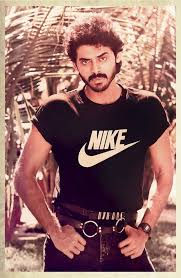
The son of a legendary producer could easily have presented his entry as destiny. Venkatesh has generally described it more simply: something happened, he accepted it, and then committed himself to doing the job properly.
That attitude would become a recurring theme in both his career and his philosophy of life.
Action hero, romantic hero, family hero — without getting trapped by any one of them

Looking only at the “family hero” label undersells how much ground Venkatesh has covered.
The early decades included the classical sensitivity of K. Viswanath’s Swarnakamalam, romance and emotion in Prema, the commercial swagger of Bobbili Raja, Ram Gopal Varma’s caper-thriller Kshana Kshanam, and the vulnerability of Chanti. He could move from an action-oriented part to an innocent or emotionally exposed character without treating either as a threat to his star image.

Then came a run of films that helped make him unusually dependable with family audiences: Pavitra Bandham, Preminchukundam Raa, Raja, Kalisundam Raa, Nuvvu Naaku Nachav, Malliswari and Sankranti. But even during that phase there were harder-edged films such as Ganesh and, later, Gharshana and Lakshmi. Suresh Productions itself lists many of these titles among the important Venkatesh films associated with the banner.
There was even a physical reason behind part of that evolution. Venkatesh said in a 2024 interview that he had done considerable action early in his career, but injuries sustained around the making of Bobbili Raja nudged him toward family-oriented cinema for a period before he eventually returned to action.
The shift proved enormously important. Telugu cinema found that Venkatesh could be heroic without always needing to dominate a frame. He could be embarrassed, henpecked, heartbroken, frightened for his family or simply ridiculous.

That ability is one reason Nuvvu Naaku Nachav remains so rewatchable decades later. The comedy does not depend upon the hero constantly reminding everybody that he is the hero. The same lack of vanity later helped him move convincingly into the middle-aged father of Drushyam, the gruff boxing coach of Guru, ensemble films such as Seethamma Vakitlo Sirimalle Chettu, the broad comedy of F2 and F3, and eventually the much darker world of Rana Naidu.
He has also been unusually comfortable with remakes. In a 2006 interview, Venkatesh explained that growing up around Chennai and being familiar with Tamil cinema helped him identify films that could work in Telugu. Chanti even travelled the other way with Venkatesh himself starring in its Hindi remake, Anari.
For an actor surrounded by the pressure of maintaining a “range,” this was pragmatism rather than embarrassment.

Awards mattered. Apparently not as much as the work.
Venkatesh’s career also accumulated substantial formal recognition. He is listed as the record-holder for the most Nandi Awards in the Best Actor category, with five wins.
Yet his own comments about milestones have frequently been strikingly unsentimental. When Saindhav was promoted as his 75th film, he said numbers such as 75 or 100 mattered less to him than approaching each movie with commitment and sincerity. He has similarly spoken about not wanting to control a film merely to protect his own image.
That may explain an unusual aspect of his longevity: Venkatesh has not needed every new phase to prove that the previous phase was obsolete.
He can return to comedy after an intense film. He can play alongside another major star. He can move into streaming. He can accept an age-appropriate role and then turn up in an unabashed festival entertainer.
In 2025, Sankranthiki Vasthunam demonstrated just how valuable that connection with family audiences still was, becoming a major theatrical success in a market increasingly dominated by large-scale action spectacles. Industry research firm Ormax Media specifically highlighted the film as an unusually strong post-pandemic success for a comedy-led Sankranti release.
The spiritual search behind the star
The most revealing part of Venkatesh’s personality, however, may be the part that has little to do with cinema.
His interest in spirituality is neither a recent publicity theme nor an occasional temple-visit headline. Interviews going back decades show a sustained engagement with questions of identity, detachment and inner peace.
A 2006 Rediff interview began by noting books on Vivekananda and Ramana Maharshi lying in Venkatesh’s room at Ramanaidu Studios. Venkatesh spoke openly about a period in which professional success itself left him restless. Hits were arriving, but the expected excitement was not. He went to the Himalayas looking for answers and later said the writings of Swami Vivekananda and Bhagavan Ramana Maharshi gradually gave him greater clarity.
That outlook offers a useful way of reading one of his old observations about stardom: “I don't identify myself as a hero. This is just a drama.”
Nearly two decades after that interview, the vocabulary has barely changed. In 2024, Venkatesh publicly spoke of meditation as a tool that helps him navigate the highs and lows of his film career.
The Zen-like Venky that audiences see at promotional events, therefore, does not appear to be merely an eccentric public persona. It has a long documented history behind it.
Why has Venkatesh rarely been drawn into star wars?

In an industry where careers can become entangled with fan rivalries, political camps and public feuds, Venkatesh has spent most of his career cultivating a conspicuously low-conflict public personality.
When specifically asked in 2024 how he had maintained a largely controversy-free career, he traced it back to his upbringing and the idea that one should avoid making other people uncomfortable.
An earlier interview provides an even clearer window into that temperament. Venkatesh spoke about wanting privacy for his children, said politics did not attract him, and explained that he preferred not to publicize charitable activity because publicizing it could turn service into comparison and self-promotion.
A star who allowed himself to age
Perhaps Venkatesh’s smartest career decision was not one decision at all. It was his willingness to keep surrendering versions of himself.
The young romantic lead disappeared. The invincible commercial hero softened. The family man aged into a father. The comic hero allowed himself to look foolish. Guru let him inhabit the weariness of an older coach. Drushyam made paternal anxiety the source of his heroism. Rana Naidu deliberately damaged the reassuring family image audiences had carried for decades.
That last experiment did provoke a backlash over the Netflix show’s profanity, sexual content and violence. Venkatesh did not pretend audiences had misunderstood him; he acknowledged that viewers had a right to object and said some of the shock-heavy material could have been handled differently.
It was a revealing response from an actor who has survived partly because he appears less interested in winning every argument than in moving on to the next piece of work.
At 40 years, still very much on the field

The 40th anniversary arrived with Venkatesh busier than the word “veteran” might suggest.
After the success of Sankranthiki Vasthunam, he shared the screen with Chiranjeevi in 2026’s Mana Shankara Vara Prasad Garu. His first film with director Trivikram Srinivas, Aadarsha Kutumbam House No: 47 — AK47, is currently scheduled for an October 2, 2026 theatrical release.
And on the very occasion of his 40-year milestone, the makers of his next film with Anil Ravipudi unveiled him as Lt. Colonel Venkat Reddy. The film also stars Nandamuri Kalyan Ram and is being positioned for Sankranti 2027.
There is something fitting about that image: at 65, four decades after Kaliyuga Pandavulu, Venkatesh is not being presented merely as somebody’s father, mentor or nostalgic guest star. He is still being introduced.
That may ultimately be the secret of his longevity.
“Victory” became the label attached to Venkatesh, but his career has increasingly suggested another definition of success: knowing that a hit will pass, a flop will pass, youth will pass, an image can pass — and still turning up for the next film without carrying the burden of having to prove who you are.
For a star who once went looking for an answer to “Who am I?”, that is an unusually appropriate way to complete 40 years.


Comments