From Telugu Debut to Tamil Icon: Khushbu’s 40-Year Southern Journey
Forty years after Kaliyuga Pandavulu introduced a 15-year-old Khushbu to South Indian audiences, her career has grown far beyond the conventional arc of a film heroine — encompassing Tamil superstardom, extraordinary fan culture, television, production, politics and, through it all, an enduring connection with Telugu cinema.
When Khushbu Sundar looked back on 40 years in South Indian cinema this week, one detail in her anniversary message carried special meaning for Telugu audiences: the journey began here.

On August 14, 1986, Kaliyuga Pandavulu arrived in theatres. Produced by D. Ramanaidu’s Suresh Productions and directed by K. Raghavendra Rao, the film introduced Venkatesh as a leading man and Khushbu to South Indian cinema. Four decades later, Khushbu remembered herself as a “gawky young 15yr old teenager” who arrived with virtually no knowledge of the South and eventually stayed to build “a career, a life and a family.”
Her description neatly captures what makes the Khushbu story unusual. She did not merely succeed in a film industry far from the world in which she grew up. She became deeply identified with the culture that adopted her.
And although Tamil Nadu would eventually turn Khushbu into a phenomenon, Telugu cinema opened the door.
Before Telugu cinema, there was Bombay
The 40-year anniversary is specifically a milestone in South Indian cinema, not the beginning of Khushbu’s acting career.
She had already faced the camera as a child artist in Hindi films. Her early work included The Burning Train, and she appeared in Hindi cinema through the first half of the 1980s before moving toward adolescent and adult roles. She was also part of Meri Jung in 1985, during the early phase of Anil Kapoor’s rise.

Then came the move that would define the rest of her career.
D. Ramanaidu, K. Raghavendra Rao and Suresh Naidu were the three names Khushbu singled out in her anniversary message, expressing what she called her eternal gratitude for introducing her in Telugu. Kaliyuga Pandavulu paired her with Venkatesh, and the film proved commercially successful.
For Telugu film followers, there is an especially charming symmetry to that beginning. Khushbu and Venkatesh were both taking major first steps, and both went on to build careers lasting four decades.
Khushbu made that personal in her anniversary note, describing Venkatesh as the friend for life she found during the journey. She said watching him grow into a major star without losing the qualities she knew in him had continued to inspire her. Venkatesh himself has similarly remembered Kaliyuga Pandavulu as the film with which his career as an actor began.
Khushbu's early Telugu association was not limited to Venkatesh. Only weeks after Kaliyuga Pandavulu, she was paired with another young actor from a celebrated film family, Nagarjuna, in Captain Nagarjun. Telugu cinema was experiencing a generational transition in the second half of the 1980s, and Khushbu found herself working amid that change.
Yet Chennai, rather than Hyderabad, would become the centre of her professional and personal world.
Becoming “Khushbu” to Tamil Nadu
Khushbu entered Tamil cinema with Dharmathin Thalaivan and quickly established herself through films including Varusham 16, Kizhakku Vaasal and Nadigan. She was also part of Singeetam Srinivasa Rao’s celebrated Kamal Haasan comedy Michael Madana Kama Rajan.
Then, in 1991, came Chinna Thambi.
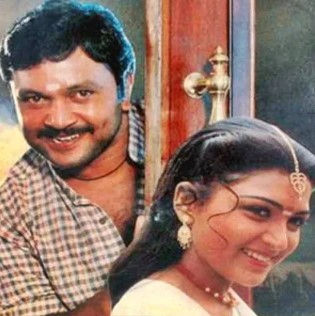
P. Vasu’s romantic drama, with Prabhu opposite Khushbu, transformed her level of celebrity. The film won major popular acceptance and Khushbu received the Cinema Express Award for Best Actress. But awards alone do not explain what happened around her in the early 1990s.
Her popularity crossed the line from movie stardom into Tamil pop culture.
Fans built a temple for her near Tiruchi — an extraordinary expression of the star worship for which South Indian cinema became famous. Khushbu herself later recalled the episode as an expression of affection from fans rather than something she had sought. Her name became so embedded in everyday popular culture that “Khushbu idli” became a familiar Tamil Nadu expression for especially soft, plump idlis.
The temple is the more spectacular anecdote, but the larger point is more interesting. Khushbu had arrived from Mumbai without Tamil as her first language, yet audiences did not continue to see her as an outsider. She became one of the recognizable faces of a particular era of Tamil popular cinema.

Films with Rajinikanth, Kamal Haasan, Prabhu, Karthik, Sathyaraj and other leading actors kept her at the centre of the mainstream during her peak years. Her career was particularly suited to the broad commercial cinema of that period — romance, family drama, comedy, sentiment and star vehicles rather than a narrowly defined screen image.
From heroine to producer — without leaving commercial cinema behind
Another important association in Khushbu’s life came through filmmaker-actor Sundar C, whom she later married.
Their partnership eventually became professional as well as personal. Through Avni Cinemax, Khushbu moved into film production, beginning with Giri in 2004 and backing commercial Tamil projects over the years. She has never been apologetic about her instinct for mainstream entertainment; in an earlier interview about her work as a producer, she explicitly described audiences outside Chennai’s multiplex circuit as central to the films she wanted to make.
That philosophy continued decades later.
Khushbu was among the producers of Sundar C’s Aranmanai 4 in 2024. At the same time, she said she was interested in broadening her production choices toward the kind of contemporary, content-driven mainstream films represented by titles such as Darlings and Badhaai Ho.
The progression is significant. Unlike many leading women of her generation whose relationship with cinema narrowed sharply once starring roles became less frequent, Khushbu found different ways of staying within the industry — actor, producer, promoter, television personality and a powerful network-builder across generations.
Television created another Khushbu
Cinema was only one part of that reinvention.
Khushbu became a familiar television presence through serials and entertainment programming, with shows such as Kalki among the projects associated with her long small-screen career. She subsequently worked across fiction, hosting, judging and television production.
That transition mattered particularly in Tamil Nadu, where television allowed established film personalities to develop an everyday relationship with family audiences far beyond the theatrical cycle of a movie release.
For Khushbu, it also ensured that her public identity did not become frozen in the 1990s.
Politics: fame became a different kind of public currency

Khushbu’s move into politics created an entirely different chapter — and at times a contentious one.
She entered active politics with the DMK in 2010, moved to the Congress in 2014 and joined the Bharatiya Janata Party in October 2020. Whatever one makes of those ideological and party transitions, they demonstrate how substantially her career moved beyond entertainment.
She contested the 2021 Tamil Nadu Assembly election from Thousand Lights as a BJP candidate but lost. In 2023, she was appointed a member of the National Commission for Women. She resigned from the commission in 2024, saying the position was limiting her ability to participate actively in politics.
In July 2025, the BJP appointed her one of the vice-presidents of its Tamil Nadu unit, a position she continues to be publicly identified with in 2026.
For a woman whose fame once produced fan temples, electoral politics represented a rather different test of celebrity. Film audiences can adore a star without asking for ideological consistency; political audiences rarely offer the same luxury.
Yet the ability to remain part of Tamil Nadu’s public conversation — through cinema, television, social questions and partisan politics — is itself one of the defining features of Khushbu’s longevity.
Telugu cinema remained part of the story
Khushbu’s greatest concentration of films may have shifted toward Tamil cinema, but Telugu audiences never entirely lost her.
Decades after Kaliyuga Pandavulu, she continued appearing in Telugu projects, including Aadavallu Meeku Johaarlu in 2022, alongside Sharwanand, Rashmika Mandanna, Radhika Sarathkumar and Urvashi.
By then, of course, the nature of the roles had changed. The teenage heroine introduced by Ramanaidu and Raghavendra Rao had become a senior performer whose presence carried its own history.
There is another elegant full-circle element to her recent work. In 2026, Khushbu appeared in the Prime Video Hindi drama Subedaar, starring Anil Kapoor and Radhikka Madan. More than four decades after her childhood work in Hindi cinema — and after appearing with Kapoor in Meri Jung during her early career — she was again part of a Hindi project with him, this time after an entire lifetime of achievement in the South in between.
Forty years — and more than one career
That may ultimately be the most interesting way to view Khushbu Sundar’s anniversary.
Her journey is not simply the familiar story of a successful heroine growing older with the industry.
It is the story of a Mumbai child artist who came to Telugu cinema at 15; a young actress who found a lifelong friend in Venkatesh; a newcomer who became so thoroughly absorbed into Tamil popular culture that fans built a temple for her; a star who turned producer; a cinema personality who became a television regular; and a celebrity who eventually exchanged film sets for election campaigns and party platforms without completely abandoning acting.
Khushbu thanked fans this week for having travelled with her through that journey, saying she would not be who she is without them.
Forty years after Kaliyuga Pandavulu, perhaps the most remarkable part is how difficult it has become to place her under any single description.
Actress works. Producer works. Television personality works. Politician works.
But for Telugu audiences looking back at August 1986, there is a simpler association worth remembering:
Before Khushbu became a Tamil cultural phenomenon, South India first met her in a Telugu film.


Comments