Can Telugu America Create a 3rd Stream of Telugu Cinema?
Updated: 3 days ago
Thirty years ago, Telugu America was primarily an immigrant audience. Then it became a crucial overseas theatrical market. Now it is slowly producing filmmakers whose stories could not have originated anywhere else.

Telugu cinema has long treated the United States as an overseas market. But as the community matures, a different possibility is emerging: movies conceived, written and made from within Telugu-American life itself. The challenge is whether passion-driven experiments can grow into a sustainable creative ecosystem — especially when Hollywood remains the bigger destination for ambitious talent.
For decades, the geography of Telugu cinema was easy to understand. The films were made primarily in Hyderabad and Chennai, consumed across Andhra Pradesh and Telangana, and exported to Telugu communities overseas.
The United States gradually became far more than another export territory. Premiere grosses became important to Telugu-film economics, Dallas and the Bay Area became major theatrical centers, and a large professional community acquired the habit of watching Telugu movies almost simultaneously with audiences back home.
Now another transition is taking place.
America is not merely where Telugu people watch Telugu cinema. It is increasingly a place where some of them want to make it.
That distinction could eventually matter.
The US is home to a substantial Telugu-speaking population. Migration Policy Institute analysis of US Census Bureau data says Telugu was the home language of about 15 percent of Indian immigrants in 2024. Earlier Census research found that the number of Telugu speakers in America increased by 4,317 percent between 1980 and 2019 — the largest percentage increase among the languages examined in that report.
That population is also becoming culturally layered. There are recent immigrants who remain closely connected to contemporary life in Hyderabad, Vijayawada, Visakhapatnam or Warangal. There are families that have lived in America for 20 or 30 years. And increasingly there are American-born children for whom Telugu identity and American identity are not competing destinations but simultaneous realities.
That creates the possibility of what might be called a third creative geography for Telugu cinema — alongside Andhra Pradesh and Telangana, a Telugu-American stream with its own subjects, rhythms and audience expectations.
It does not exist as an industry yet. But its early building blocks are visible.
The idea is older than it appears

Telugu cinema began looking seriously at immigrant life long before the present US population boom.
The first Telugu movie to be shot in the United States was C.V. Sridhar's Hare Krishna Hello Radha, starring Krishna, Sripriya and Rati Agnihotri in 1980. At a time when taking an Indian film unit to America involved enormous expense and logistical difficulty, producer B. Bharani Reddy and Sridhar travelled with a deliberately small crew.
K. Vasu's America Alludu (1985) and Jandhyala's Padamati Sandhya Ragam (1987) remain important early landmarks, which were partly made in the United States. They centered on Indian families in the United States. Its American setting was not merely scenery; cultural displacement was the story.
Later filmmakers approached migration from different directions. Sekhar Kammula's Dollar Dreams emerged from his observations after returning from the United States and focused on the enormous attraction America held for young Indian professionals around the turn of the century.
But perhaps the most instructive precedent is Deva Katta.
Before Prasthanam made him widely known as a Telugu filmmaker, Katta was an engineer working in the United States. He attended filmmaking courses in Detroit and made Valasa, a project about Indian students in America, using friends and acquaintances rather than professional actors.
After showing that work to Telugu NRIs in Detroit, he found investors for his first commercial feature, Vennela. Katta has recalled that around 25 to 32 US-based investors participated, some with relatively small contributions. The experiences of Indian students in America that he had observed became the foundation for the film.
That story contains a blueprint that remains relevant two decades later:
professional career in America → passion for cinema → local experimentation → community financing → feature film → entry into mainstream Telugu cinema.
The difference today is that filmmakers do not necessarily have to complete the final step by moving back to Hyderabad. They can potentially remain in America.
The software engineer with a camera is no longer a joke
One recurring characteristic of US-made Telugu independent cinema is that its filmmakers often have another profession.
That can look like a weakness. It may actually be the movement's starting capital.
The makers of the 2020 Telugu thriller Gatham were largely US-based professionals. Actor-producer Bhargava Poludasu told the International Film Festival of India that the team was working in software and had to find time around their jobs to complete the film. Production involved difficult winter conditions in California and a small crew whose members performed multiple jobs.
The result nevertheless reached Amazon Prime Video and was selected for the Indian Panorama at the 51st International Film Festival of India.
That is significant not because Gatham created a new industry overnight but because it demonstrated what digital filmmaking and OTT distribution had made possible: people with no conventional Tollywood infrastructure could produce a Telugu feature in America and place it before a global audience.
The model continues.
San Francisco-based actor Rakesh Galebhe has described maintaining his technology career while acting in US-produced Telugu projects, sometimes scheduling major shoots during Christmas holidays and smaller work over long weekends.
This is filmmaking built around PTO (Paid Time Off), weekends and personal savings rather than call sheets issued by a Hyderabad studio. It is obviously difficult to sustain. But many independent film movements begin with people who have more conviction than infrastructure.
A more interesting change: America is becoming the subject
Simply shooting a Telugu movie in California does not create Telugu-American cinema.
For years, mainstream Telugu films have filmed songs, romances and action sequences in the United States. Those remain Hyderabad productions using America as a location.
A more distinctive cinema begins when the American experience itself generates the screenplay.
Sripal Sama's How Is That for a Monday? offers one example. The Telugu-English independent film was shot entirely in the US and follows, among others, an immigrant technology worker dealing with a sudden career setback while the narrative also engages with race, policing and class. It subsequently received theatrical exposure and was acquired by ETV Win.
More recent short films indicate an even more localized storytelling impulse.
The 2025 Indie Meme Film Festival in Austin programmed two US-made Telugu shorts, Lost in Concrete Woods and Smoke Cheyyaku Bro. One deals with an ambitious man's isolation after his controlled routine collapses; the other begins with the emotional consequences of losing a job.
Dallas later hosted an “Indie Sitralu” event at the Angelika Film Center specifically showcasing Telugu independent cinema, including Lost in Concrete Woods.
And in Minnesota, Rudram offers perhaps an even clearer example of an American social issue being processed through a Telugu-language film. The US-produced feature places its characters in a story involving drug diversion and the opioid crisis, while incorporating mythology and family relationships. It was selected for the 2026 South Asian Indian Film Festival Florida.
These are not films about an NRI hero arriving at an airport. America has become their lived environment. That is an important distinction.
The second generation changes everything
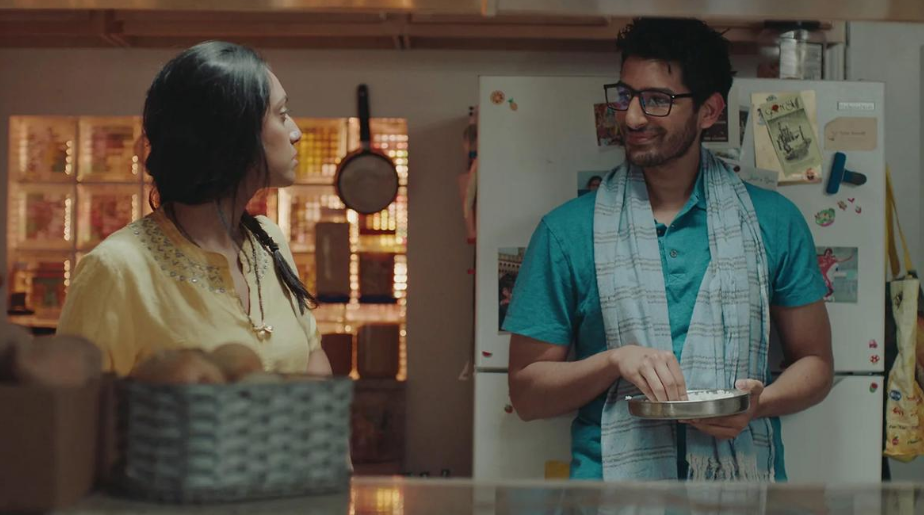
The first major Telugu migration narratives generally revolved around movement: leaving India, arriving in America, acquiring a visa, adjusting to Western culture, marrying across cultures, succeeding abroad or deciding whether to return.
A second-generation Telugu-American filmmaker starts from an entirely different place.
America is not the destination. It is home.
That opens up stories mainstream Telugu cinema has barely explored: parents and children who switch languages during the same argument; teenagers who understand Telugu perfectly but answer in English; grandparents who spend six months each year in suburban America; inter-Indian and interracial marriages; women rebuilding careers after migration; immigration status affecting family decisions; American-born children negotiating expectations imported from India; loneliness inside prosperous technology households; or elderly parents realizing their grandchildren belong to a culture they only partly understand.
California-based filmmaker Kalyan Sura is developing precisely this territory.
His short Dos Bros Force received support from the Netflix x Tasveer Film Fund. Sura says he is now expanding it into a Telugu-English family dramedy set in 1990s California, centered on immigrant parents, children and the gap between what each generation understands as sacrifice, success and belonging. Tasveer's records confirm the project as a film-fund recipient.
The important creative decision is the bilingualism.
A genuinely Telugu-American film may not be entirely in Telugu — and forcing it to be could actually make it less authentic.
A mother might speak Telugu. Her son might answer in English. The parents could switch to Telugu when they do not want the children's friends to understand. The children could use Telugu with grandparents but English with siblings. That linguistic movement is itself part of Telugu-American culture.
But where will the actors come from? This is where the proposed “third stream” faces a structural problem.
Any highly talented American-based actor is operating within reach of the world's largest English-language screen industry. If that performer can obtain substantial opportunities in Hollywood, American television or major streaming productions, the economic and professional incentives are obvious.
A small Telugu-American independent film cannot compete with Hollywood on salaries, visibility, agents, production infrastructure or career scale.
That means some early Telugu-American productions will inevitably depend on people who have another profession, actors still seeking larger opportunities, theatre performers, newcomers and filmmakers willing to work for passion rather than immediate financial reward.
That reality should not be romanticized. But it should not be interpreted to mean that Telugu-American cinema can only be populated by people who “failed” to enter Hollywood.
The relationship could be much more fluid.
American-born Telugu actress Avantika Vandanapu, for instance, has already demonstrated how a performer can move between Telugu cinema and mainstream American entertainment. Discussing reactions to her American accent in 2024, she pointed out that she was born and raised in the US and described the code-switching familiar to immigrant children.
For the next generation, “Tollywood or Hollywood” may be the wrong choice altogether.
A Telugu-American actor could work in an American series, audition for studio films and still appear in an independent Telugu-English feature if the role offers something Hollywood does not.
That “something” is cultural specificity.
Hollywood can cast an Indian-American character.
It is much less likely to finance a film specifically about a Telugu household in Frisco, Texas, where the parents came from Guntur, the children grew up watching the Dallas Cowboys, grandparents arrive every summer, and the family's emotional life shifts continuously between Telugu and English.
A good actor may accept a smaller Telugu-American production not because Hollywood rejected them, but because Hollywood is unlikely to tell that particular story.
Writers and directors may therefore arrive before stars
For this reason, the most important people in an emerging Telugu-American cinema may initially be writers and directors rather than actors.
Actors benefit enormously from joining the biggest available market. For writers, cultural specificity can be an advantage.
A filmmaker who has lived for 20 years in New Jersey understands things a writer sitting in Hyderabad may not fully know. An American screenwriter with no Telugu background would miss another layer entirely.
The filmmaker who understands both worlds owns a valuable perspective. That is why the most promising Telugu-American stories may not imitate mainstream Telugu films at all.
They may resemble American independent cinema: smaller casts, real locations, modest budgets, bilingual conversations, fewer songs, less hero-centric storytelling and greater emphasis on relationships, social observation and character.
They could also eventually expand beyond immigrant drama.
A healthy Telugu-American film culture should be able to produce a suburban thriller, workplace comedy, horror film, science-fiction story or murder mystery without every movie needing to explain what it means to be an immigrant.
A Telugu family in Texas should eventually be allowed simply to exist on screen.
OTT solved one problem — but not all of them
Digital distribution has made this possibility much more realistic than it was in the Vennela era.
Gatham reaching Amazon Prime Video and How Is That for a Monday? finding a home on ETV Win showed that an American-made Telugu independent film can move beyond community screenings.
Festivals provide another pathway. Indie Meme in Austin is already programming Telugu-language shorts. The New Jersey Indian and International Film Festival explicitly lists Telugu among the regional cinemas it wants to support while seeking stronger connections between filmmakers in India and the United States. But OTT has not eliminated the hardest problem.
Someone still has to finance the film before a streaming platform can acquire it. That is the missing middle.
Telugu America has audience wealth, technology professionals, entrepreneurs, actors, theatre groups, cinematographers and people with intense enthusiasm for cinema. What it does not yet have is a consistent system connecting those resources.
What a real Telugu-American film movement would need
Imagine something more organized than one group of friends deciding to make a movie. A Telugu OTT platform, a few diaspora investors and US-based film organizations could establish an annual Telugu-American film fund.
Select three to five scripts. Keep the budgets disciplined. Pair emerging US writers and directors with experienced Telugu or American film professionals. Develop actors locally.
Use Dallas, Austin, the Bay Area, New Jersey, Seattle, Chicago or Atlanta not because America looks glamorous, but because the stories actually belong there.
Give completed projects a festival strategy, limited theatrical screenings in major Telugu-American centers and a guaranteed digital window.
The goal would not be to manufacture another ₹100-crore “pan-India” film.
It would be to create an ecosystem. One successful director could emerge from five films. One actor could cross into Hollywood. Another could move into mainstream Telugu cinema. A writer could enter an American television room. A cinematographer could begin working professionally across both markets. Success would therefore not mean keeping talent trapped inside “Telugu America.” Quite the opposite.
The ecosystem would become valuable if it could generate talent capable of moving outward while continuing to bring stories back.
Not Tollywood USA — at least not yet
It would be premature to call this “Tollywood USA.”
There is no continuous production slate, reliable financing system, dedicated distribution network or professional talent pool large enough to constitute a parallel film industry.
Most projects remain isolated experiments. Many are dependent on personal money and volunteer labor. Some will inevitably have amateur performances or technical shortcomings. Others may never find distribution.
And the gravitational pull of both Hollywood and Hyderabad will remain powerful. But that does not make the experiments unimportant.
Thirty years ago, Telugu America was primarily an immigrant audience. Then it became a crucial overseas theatrical market. Now it is slowly producing filmmakers whose stories could not have originated anywhere else.
The first generation of Telugu-American cinema largely asked: What happens when a Telugu person goes to America?
The next generation can ask something much more complicated: What happens when Telugu people have been in America long enough for America to become part of Telugu culture itself?
If filmmakers begin answering that question consistently, Telugu cinema may acquire something genuinely new — not a competitor to Hyderabad and not a substitute for Hollywood, but a third creative stream positioned between them.
Its defining characters may not be film-industry insiders at all.
They may be software architects shooting during Christmas vacation, immigrant parents investing a few thousand dollars, American-born children writing bilingual scripts, actors auditioning for Hollywood during the week and performing in Telugu on weekends.
That apparent weakness — the absence of a conventional industry — may be exactly how the movement begins.


Comments